
Running a Sex Offender Check in Lunenburg County
The Virginia Sex Offender and Crimes Against Minors Registry is the official public source for Lunenburg County registry records. The Virginia Department of State Police, or VSP, maintains that statewide system. Lunenburg County does not publish a separate county registry database, so a county search should not begin with an unofficial list. Searchers can use a known name, a county or locality, or an address-based area. The best choice depends on whether the goal is to confirm one profile or understand who is registered near a place.
The Lunenburg County Sheriff's Office performs local law-enforcement duties, while VSP controls the public registry and its profiles. If a searcher knows a person's name, first and last name are the cleanest starting fields. For community awareness, use Lunenburg County as the locality and then compare it with a precise street-address radius. Keep Victoria and Kenbridge in the query when town context matters. Similar place names in other states can otherwise lead a rushed reader to the wrong result set.
Lunenburg Registry Roles
VSP and the Lunenburg County Sheriff have related but distinct registry roles. VSP maintains the Virginia registry, publishes searchable data, and fields registry questions at (804) 674-2825 or sor@vsp.virginia.gov. The sheriff is the local law-enforcement contact when an address in Lunenburg County appears wrong or possible noncompliance requires review. The official sheriff directory and Lunenburg County government gateway identify the local office, whose published address is 160 Courthouse Square and phone is (434) 696-4452.
Do not treat the sheriff as a second public search engine. The public-facing record remains the VSP profile. The local office can receive a good-faith concern, identify the right enforcement channel, and help route a report. State the profile, disputed address, and reason for concern with care. Do not confront the person or publish an accusation. A map mismatch, old address, or missing field may reflect timing, statutory limits, or geocoding rather than a violation.
Searching the Virginia Sex Offender and Crimes Against Minors Registry
The state registry offers person and geographic paths for a Lunenburg County sex offender lookup. Its live controls can change, so read the on-screen labels and terms before entering data. Core options documented by the research include names and aliases, street or address, city, ZIP code, county or locality, radius tools, and map or list results. Search and reset controls help refine the request. A required warning or disclaimer must be accepted before results appear.
- Open the official VSP registry and read its conditions of use. Accept the warning only after noting its limits.
- Choose a person search for a known name or a geographic search for a Lunenburg County address, town, ZIP, or locality question.
- Review the result list and compare identifiers. Do not rely on a name alone when profiles show more detail.
- Open the full profile, check update and compliance information, and read the offense jurisdiction before drawing any conclusion.
| Field Label | Type | Required | Notes |
|---|---|---|---|
| Last name | Text | Path dependent | Use for a known-person search |
| First name | Text | Path dependent | Use with other identifiers when possible |
| Street, city, or ZIP | Text or select | Path dependent | Supports place-based searching |
| County or locality | Select | Path dependent | Choose Lunenburg for a county result set |
| Distance, map, or list | Geographic controls | Path dependent | Use displayed choices; do not assume a radius |
These are the documented core controls, not a claim that every field is always shown or mandatory. The live portal decides which controls apply to each path.
Lunenburg County Radius Results
A county filter and an address-radius search answer different questions. The county option asks for profiles assigned to Lunenburg County. A radius starts at one mapped point and may cross a town or county line. That distinction matters across rural Southside Virginia, where a mailing city, road location, ZIP boundary, and legal county can point to different geographic sets.
Use a full, precise address when the concern is one home, school route, or nearby block. Use the Lunenburg County filter when the concern is countywide awareness. If Kenbridge or Victoria is typed as a locality, confirm that Virginia is selected. Rural routes, recent moves, mailing addresses, and geocoding can shift the dots shown on a map. A result that differs between two methods is a reason to compare the query settings, not proof that a profile is false or missing.
What a Registry Profile Shows
A public registry profile is a fielded government record, not a full biography and not a current-risk assessment. The live VSP portal controls what appears. A typical profile can provide identity details, a photograph and physical traits, registered locations, vehicles, status dates, and qualifying-offense information. Some fields may be absent or withheld because of law, safety needs, or law-enforcement limits. Read what is displayed without filling gaps with assumptions.
| Name and aliases | Published names and alternate names used to distinguish the listed person |
|---|---|
| Photo and description | Photograph plus permitted sex, race, age or birth details, height, weight, hair, eyes, and identifying marks |
| Registered locations | Residential address and any employment, school, or volunteer location made public by law |
| Vehicle information | Vehicle details when the registry makes them public |
| Qualifying offense | Description, jurisdiction, conviction date, and victim-age category when provided |
| Status and dates | Registration or compliance status plus registration, update, or verification dates shown by VSP |
The profile should be checked again when the information will guide a safety plan. A saved image or old printout may not reflect a later update.
Read Lunenburg Profiles Carefully
Virginia's tier label follows statutes and qualifying offenses. It is not a personal score for how dangerous someone is today. The same caution applies to blank fields. An item that does not appear on a Lunenburg County profile is not proof that the fact does not exist. It may not be collected, public, relevant, or available in that profile layout.
The registry may show a conviction jurisdiction and date, but it is not a court docket. Readers seeking the filed charge, orders, or final disposition should verify those documents through the court that handled the case. For broader county record context, the Lunenburg County criminal history overview explains why court, arrest, booking, and statewide records can differ. Keep the registry's purpose narrow: confirm published registration information and use it for lawful awareness.
Registration Requirements and Levels in Virginia
Virginia uses Tier I, Tier II, and Tier III classifications tied to listed offenses and federal alignment. The tiers must not be relabeled low, medium, or high risk. Duration and verification duties can turn on the actual offense statute, amendments, juvenile provisions, and eligibility for reduction or removal. The general frameworks below are useful orientation, but the current Registry Act and the individual profile must control any firm conclusion.
| Level / Tier | Duration | Verification Frequency |
|---|---|---|
| Tier I | Generally 15 years | Verify the current Code and offense-specific rule |
| Tier II | Generally 25 years | Verify the current Code and any special rule |
| Tier III | Generally lifetime | More frequent verification; confirm the current statute |
Virginia Code § 19.2-390.1 documents the state's registry-maintenance framework. The captured statute page helps show why VSP, rather than Lunenburg County, is the authoritative public source.
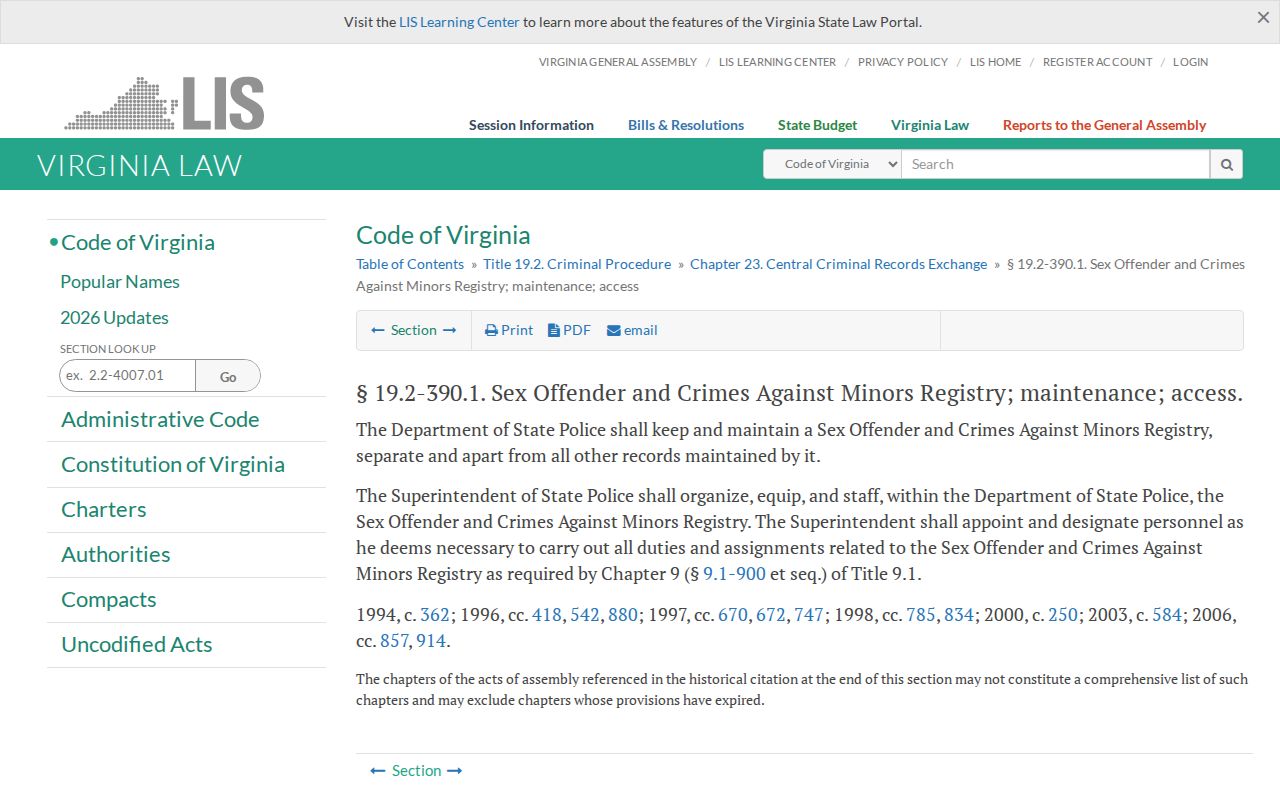
The official law page anchors the division of responsibility between the statewide system and local enforcement contacts.
Lunenburg County SP-285 Notices
VSP Form SP-285 provides a notification channel beyond repeatedly running the same search. The form allows a person to request notice of registration or re-registration by a sex offender located in the same ZIP code or a contiguous ZIP code. That ZIP-based scope is not the same as the Lunenburg County boundary or a hand-drawn map radius. Read the current form and registry instructions before relying on it.
For a rural resident, SP-285 can add a passive alert layer while the county and address searches remain available for spot checks. It does not replace profile review. A notice should still be matched to the state registry entry, update date, and displayed offense information. Questions about enrollment belong with VSP registry staff. Local concerns about a Lunenburg County address can also be routed to the sheriff without direct contact with a listed person.
Lunenburg and National Registry Search
The U.S. Department of Justice National Sex Offender Public Website, or NSOPW, adds a cross-state search layer. It is useful when a person or address history may extend beyond Virginia, or when a nearby search area crosses a state system's reach. It does not make the VSP registry obsolete. Virginia remains the best source for the state's own profile fields and status information.
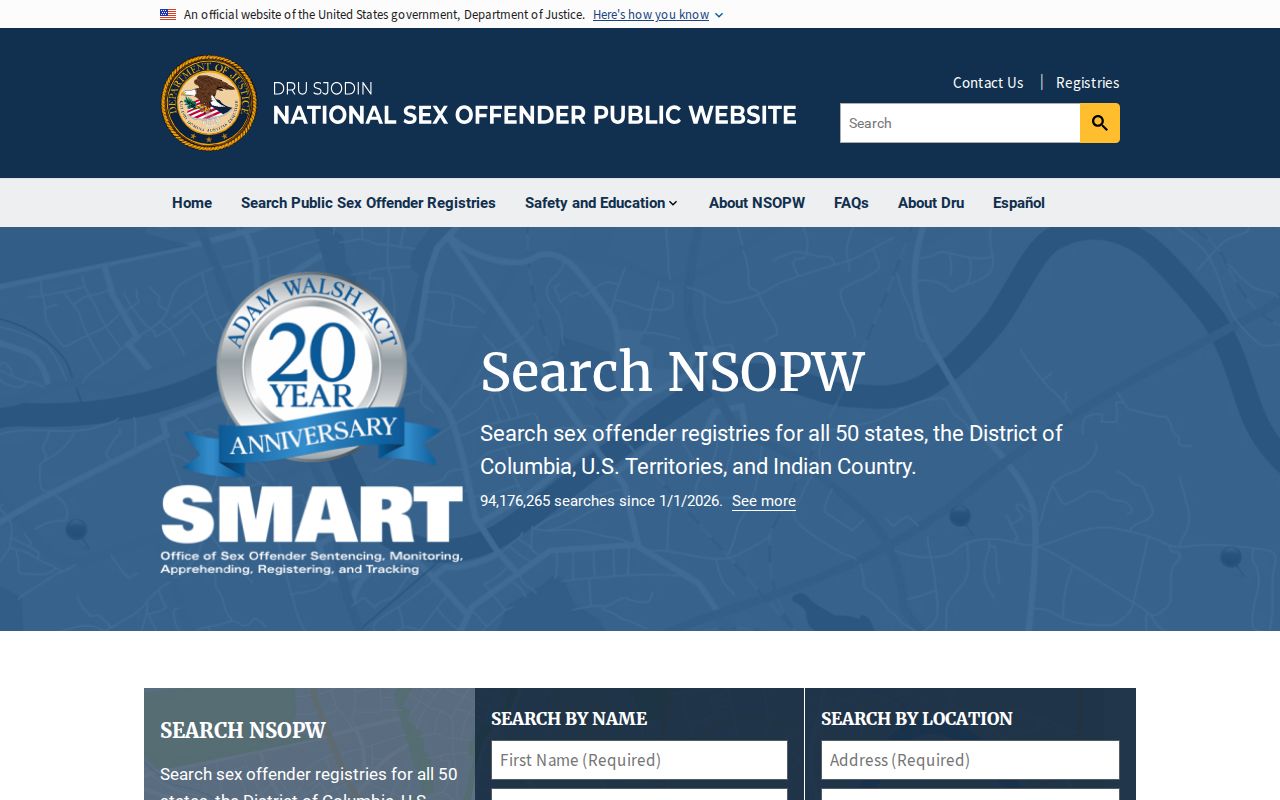
The national search is most useful as a second pass after the Lunenburg County and Virginia queries are complete.
Compare identifiers and jurisdictions when NSOPW returns a possible match. Names can repeat, and a cross-state result may reflect a different person. Open the linked state record when available and confirm the profile there. If the national and Virginia results appear inconsistent, record the search terms and contact the relevant registry office rather than guessing which page is current.
Wrong Lunenburg Registry Address
When a profile address appears wrong, first rerun the search with a county filter and then with the exact address. Check whether the concern is a map point, mailing city, old update date, or a different person with a similar name. Save the public profile URL or note enough public details for registry staff to locate it. Do not gather private facts or visit the address to test the listing.
Report a suspected error or noncompliance issue to VSP at (804) 674-2825 or sor@vsp.virginia.gov and to the Lunenburg County Sheriff's Office at (434) 696-4452 when local review is appropriate. Explain the specific mismatch without asserting guilt. Staff can decide whether the record needs a data correction, a compliance check, or no action. That process protects both public safety and the accuracy of the official record.
Lawful Use and Community Notification
The registry supports public protection, personal safety planning, and community awareness. Virginia Code § 9.1-912 governs public dissemination. Its public purpose does not turn a profile into permission to confront, shame, threaten, or target a listed person or household. Treat each Lunenburg County result as government information to read and verify within the portal's stated terms.
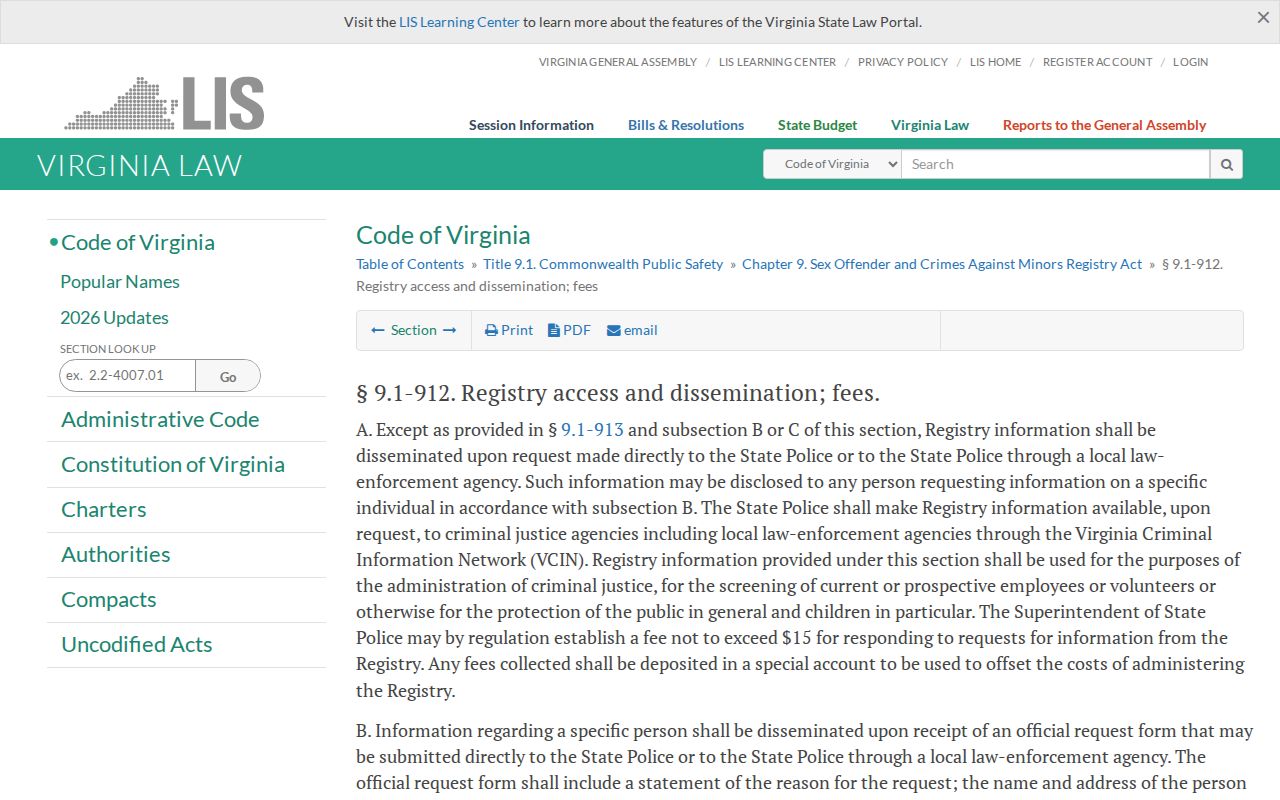
The statute page places public access beside firm limits on misuse, which is essential context for every Lunenburg County registry search.
Misuse is a crime: Virginia Code § 9.1-912 states that registry information may not be used to intimidate or harass another person, and using it to commit a crime is punishable under Virginia law. Do not threaten, confront, or take vigilante action.
For routine awareness, use the registry, SP-285 notices, and NSOPW as separate tools with different scopes. For a suspected error, contact VSP and the sheriff. If there is an immediate threat, use the appropriate emergency channel rather than trying to investigate through registry data.